RBI Guidelines for Recovery Agents 2026: What Banks and NBFCs Must Change Before 1 January 2027
The RBI's recovery agent directions take effect on 1 January 2027. This lender-side checklist maps each requirement to the collections team it affects, from agent certification and contact hours to call records, agency lists and grievance details.

On 6 August 2026 the Reserve Bank of India issued amendment directions on the conduct of regulated entities in recovery of loans and engagement of recovery agents. They take effect on 1 January 2027 and cover banks and NBFCs, among other lenders (RBI press release 2026-2027/827).
This guide reads the new RBI guidelines for recovery agents from the lender's side. For each requirement, you will see which part of your collections operation it changes and what to check before the deadline.
This is general information drawn from RBI pages and secondary summaries. It is not legal advice.
What the RBI issued on 6 August 2026, and who it covers
Many people search for "RBI recovery practices directions 2026". No instrument carries that title. The RBI issued nine parallel amendment directions, one per entity type, under a press release titled "Conduct of Regulated Entities in Recovery of Loans and Engagement of Recovery Agents" (RBI, CorpLawUpdates).
Each instrument amends the Responsible Business Conduct Directions of its entity type. Two examples:
NBFCs: Reserve Bank of India (Non-Banking Financial Companies - Responsible Business Conduct) Third Amendment Directions, 2026 (RBI/2026-27/230), which adds paragraphs 100A to 100AB (RBI).
Commercial banks: Reserve Bank of India (Commercial Banks - Responsible Business Conduct) Fourth Amendment Directions, 2026 (RBI/2026-27/223) (RBI).
Scope differs by instrument. The commercial bank directions exclude Small Finance Banks, Payments Banks, Regional Rural Banks and Local Area Banks (TaxGuru). Small Finance Banks, Regional Rural Banks and Local Area Banks have their own parallel instruments (RBI, SFB directions). The sources we reviewed do not show a separate instrument for Payments Banks.
The NBFC directions apply to all NBFCs except Mortgage Guarantee Companies, Core Investment Companies, NBFC-Account Aggregators, Standalone Primary Dealers, Non-Operating Financial Holding Companies and NBFCs with no customer interface.
Housing finance companies are brought in through their own amendment, which requires HFCs to comply with NBFC paragraphs 100A to 100AB (RBI, HFC directions). Urban co-operative banks have their own text as well (RBI, UCB directions).
Outsourced recovery also sits under the RBI's Managing Risks in Outsourcing Directions, 2025, which the new texts cross-refer for due diligence (RBI).
From draft to final: the dates that matter
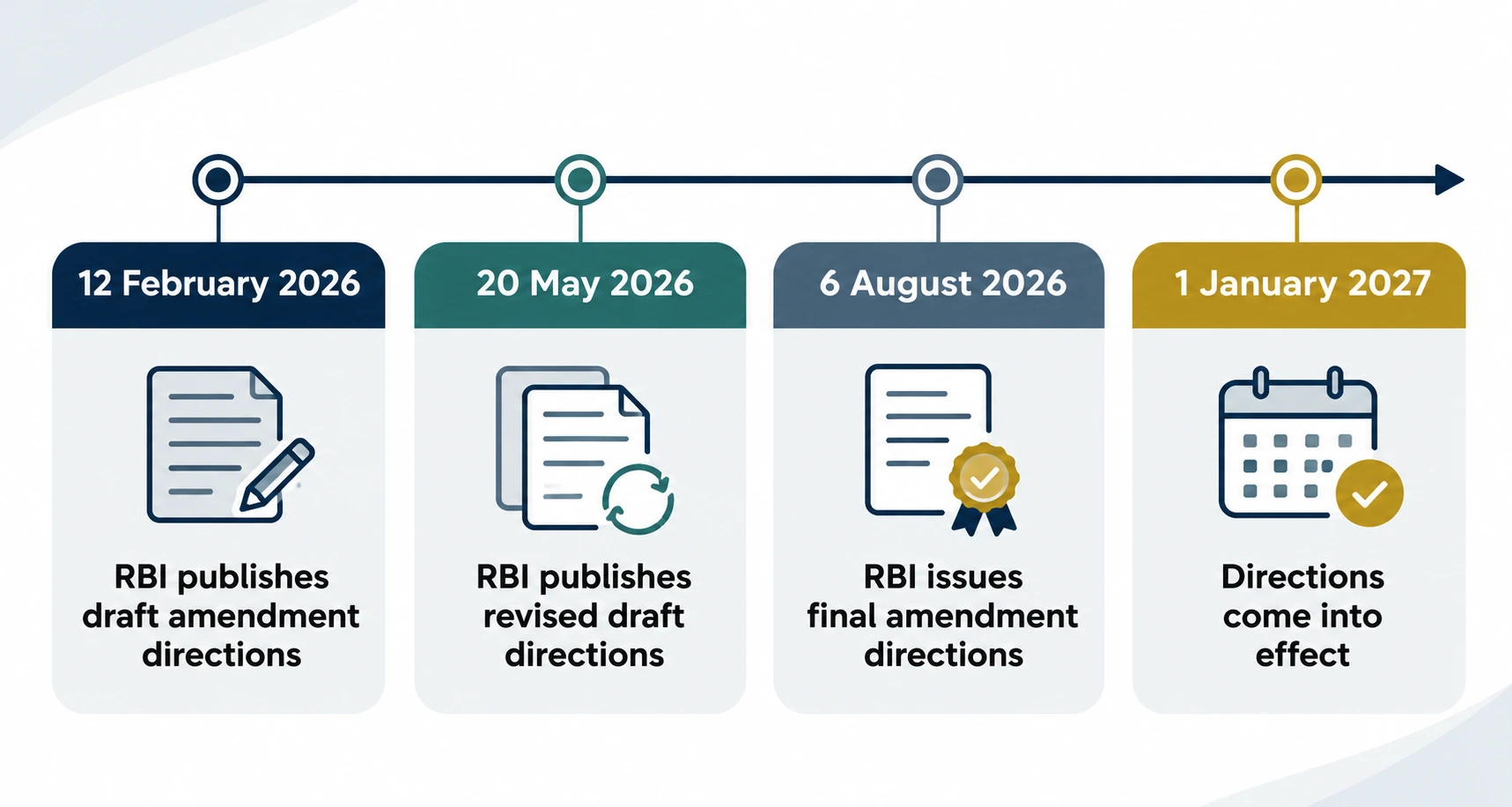
If you are tracking the new directions, four dates matter:
12 February 2026: RBI publishes draft amendment directions (RBI).
20 May 2026: RBI publishes revised draft directions (RBI).
6 August 2026: RBI issues the final amendment directions (RBI).
1 January 2027: the directions come into effect.
The two drafts were proposals for consultation. Recheck rbi.org.in before you act, in case the RBI amends the effective date.
The readiness checklist: each requirement and the part of collections it changes
The RBI rules for recovery agents touch almost every team in a collections operation. The table below assigns each requirement to the function most likely to own it. Paragraph numbers differ by entity type, so confirm each item against your own instrument.
Requirement | Part of collections it changes | Likely owner | Status |
|---|---|---|---|
Written recovery policy covering escalation, code of conduct, agency due diligence and borrower compensation | Policy and governance | Compliance, risk | Required |
Agents hold an IIBF Debt Recovery Agent certificate | Agency onboarding | Vendor management | Required (transition varies by entity) |
Due diligence on agencies before and during engagement | Vendor oversight | Vendor management, audit | Required |
Contact only between 08:00 and 19:00 unless the borrower or guarantor asks otherwise | Field and tele-calling | Collections operations | Required |
Agency details shared at least one day before the first in-person visit | Field visits | Field operations | Required |
Calls recorded and kept for six months | Records | Operations, technology | Required |
Public list of recovery agencies, updated within seven calendar days | Transparency | Compliance, web team | Required |
Grievance officer details in every recovery communication | Notices and templates | Customer service, legal | Required |
Device restriction thresholds at 30 and 60 days past due | Device-financed portfolios | Product, technology | Required where applicable |
Keep recovery policy separate from DSA/DMA code of conduct | Policy design | Compliance | Commentary |
In short: most items are operational. They need named owners, written processes and evidence you can produce on demand.
Policy and governance: a written recovery policy
The NBFC directions require a recovery policy covering escalation, a code of conduct, due diligence on recovery agencies and compensation for borrowers (RBI, CorpLawUpdates).
In professional commentary, Vinod Kothari & Company advises keeping the recovery policy separate from the DSA/DMA code of conduct policy (Vinod Kothari). This is advice, not a requirement.
Agency onboarding and certification: IIBF Debt Recovery Agent credentials
The directions draw a line between two terms. A recovery agency is an entity or individual, other than the lender's own employees, engaged under an outsourcing arrangement to recover dues. Business Correspondents doing recovery fall within this definition. A recovery agent is the individual who deals with the borrower (RBI).
Agencies may engage only agents who hold the Indian Institute of Banking and Finance (IIBF) Debt Recovery Agent certificate, or who trained at an institute tied up with IIBF (RBI, NBFC, RBI, UCB).
The transition period is entity-specific. The NBFC directions (paragraph 100I) and the UCB text (paragraph 325I) give existing uncertified agents one year from 1 January 2027. The commercial bank text, as summarised by TaxGuru, shows no separate transition.
Do not assume a one-year window applies to you. Check your own instrument.
Vendor due diligence and who stays accountable
The directions require due diligence and antecedent verification of recovery agencies before engagement and periodically after, in line with the Managing Risks in Outsourcing Directions, 2025. Incentive structures for agencies must not induce harsh recovery practices (RBI, TaxGuru).
These directions do not stop you outsourcing recovery. Commentary from Vinod Kothari & Company treats the lender as remaining responsible for outsourced recovery (Vinod Kothari). In our view, outsourcing moves the work, not the responsibility.
Contact conduct: hours, first-visit notice, social media and microfinance
Three rules shape daily field and tele-calling work:
Contact hours. Recovery staff and agents may contact or visit borrowers only between 08:00 and 19:00, unless the borrower or guarantor expressly requests or authorises otherwise (RBI, NBFC, RBI, UCB).
First-visit notice. The lender must share the recovery agency's details with the borrower at least one day before the first in-person visit (RBI).
Social media. Misusing social media, such as posting call recordings or a borrower's personal details, counts as a harsh recovery practice (TaxGuru). The directions list other harsh practices too.
For microfinance loans, the NBFC directions (paragraph 100Y(7)) place collection at a designated place agreed with the borrower. Field staff may visit a residence or workplace only after the borrower misses two or more successive appointments (RBI). This summary paraphrases the RBI page. Check the exact wording in the official text.
Records and transparency: call recording and the agency list
Recovery calls must be recorded, capturing time, number and content. Recordings are kept for six months, or until disposal where the matter is sub judice. Borrowers must be told their calls are recorded (RBI, TaxGuru). Some lenders already record calls. The task is to confirm your retention and disclosure match the text.
You must also publish a list of your recovery agencies on your website and update the list within seven calendar days of any change (RBI). The NBFC text asks for agencies, not individual agents.
Grievance handling in every recovery communication
The directions require a dedicated mechanism for recovery-related grievances, disclosed in loan agreements and recovery notices. Every recovery communication must carry the grievance officer's name, email, phone number and address (RBI, NBFC, RBI, UCB).
A draft of the NBFC text had proposed barring a lender from forwarding a case to staff or agencies while a related grievance was pending (RBI draft). Based on the RBI page summary and Vinod Kothari's commentary, this bar was not carried into the final NBFC text. We have not checked the commercial bank position on this point.
Device restrictions on financed devices
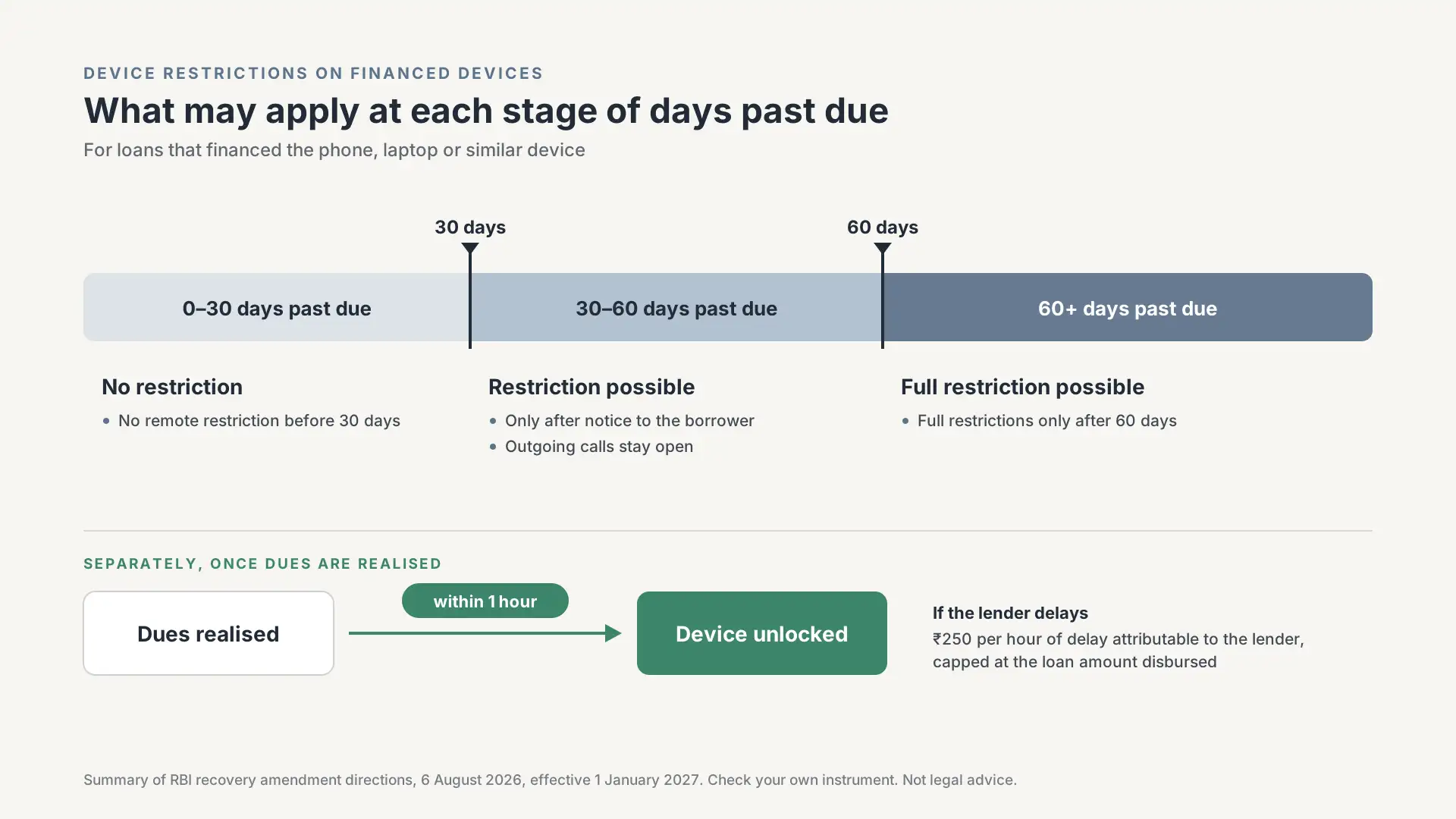
If your portfolio finances phones, laptops or similar devices, the directions set limits on remote restrictions (RBI, TaxGuru):
No restriction before 30 days past due, and only after notice.
Full restrictions only after 60 days past due. Outgoing calls stay open until then.
Unlock within one hour of dues being realised.
Compensation of Rs 250 per hour for delay attributable to the lender in lifting a restriction, capped at the loan amount disbursed.
These are regulatory parameters for loans that financed the device. Vinod Kothari & Company notes the meaning of "per hour" in the compensation rule is unclear (Vinod Kothari).
What is required, and what is only good practice
Keep two lists. Mixing them leads teams to treat advice as law, or law as optional.
Required by the directions (check your instrument)
A written recovery policy with the elements listed above.
IIBF-certified recovery agents, subject to any transition in your text.
Due diligence on agencies before and during engagement.
Call recording with six months' retention.
A published agency list and grievance details on every recovery communication.
Good practice, in our operational judgement
Keep the recovery policy as its own document, separate from the DSA/DMA code of conduct, as Vinod Kothari & Company advises.
Give each checklist item a named owner and a record you can show an auditor.
What to verify in your own instrument before you act
Summaries, including this one, compress detail. Before 1 January 2027:
Confirm which of the nine instruments applies to your entity type.
Read your paragraph numbers on rbi.org.in. Paragraph numbers here come from RBI page summaries, not the full PDF text, so read the official PDF on rbi.org.in yourself.
Check whether your text gives existing agents a transition period for certification.
Recheck the effective date for any later amendment.
Ask counsel where your reading is unclear.
Frequently asked questions
When do the new recovery rules apply?
From 1 January 2027. Recheck rbi.org.in for any later amendment before you finalize internal policies.
Which lenders do they cover?
Commercial banks, small finance banks, local area banks, regional rural banks, urban and rural co-operative banks, all-India financial institutions, NBFCs (with listed exceptions) and HFCs, each under its own instrument. The sources we reviewed do not show a separate instrument for Payments Banks. Find the instrument for your entity type.
Do recovery agents need certification?
Yes. Under the directions, agents need the IIBF Debt Recovery Agent certificate. The transition window for existing agents depends on your entity's text.
Does outsourcing recovery move the responsibility to the agency?
Not in our reading. You may outsource with due diligence, and commentary from Vinod Kothari & Company treats the lender as remaining responsible.
Conclusion
The work before 1 January 2027 is operational: a written policy, certified agents, recorded calls, a published agency list and grievance details on every notice. Each item needs an owner and evidence. The accountability stays with you whichever partner makes the calls.
e-Solve Group is not regulated or approved by the RBI. We build our collections operation to the standards our regulated clients must meet, and we are glad to talk through how these RBI guidelines for recovery agents apply to your portfolio.
Which item on this checklist would take your team longest to evidence if an auditor asked on 2 January 2027?
Sources
RBI (Housing Finance Companies) Third Amendment Directions, 2026 (RBI/2026-2027/231)
RBI Press Release 2025-2026/2099: Draft Amendment Directions
RBI Press Release 2026-2027/298: Revised Draft Amendment Directions
RBI: Draft NBFC Responsible Business Conduct Amendment Directions, 2026 (draft)
Vinod Kothari & Company: RBI's Recovery Norms Allow Device Locking by Lenders
Taxmann: RBI Issues Revised Draft Directions on Recovery of Loans and Recovery Agents
Taxmann: RBI Proposes Stricter Norms for Loan Recovery and Recovery Agents