RBI Guidelines for Recovery Agents vs Collection Agents: How to Classify Your Vendors
A lender-side guide to the RBI Amendment Directions of 6 August 2026, explaining the definitions of recovery agencies and agents, the limits of contractual labels, unconfirmed reporting on instalment-only collectors, and key obligations and contract terms to review before 1 January 2027.

Pull your vendor contracts and read the role descriptions side by side. One agency is a "recovery partner". Another, doing similar field work, is a "collection partner". A third is an individual you engaged directly. Under the RBI guidelines for recovery agents issued on 6 August 2026 and effective 1 January 2027, the label on those contracts carries little weight. The directions define "recovery agency" and "recovery agent" by function. One reported carve-out, for agents who only collect regular instalments, has not been confirmed in the operative text we could access (TaxUpdate.in, CorpLawUpdates).
This piece stays on one question: which of your vendors fall inside the definitions, and what your contracts need to carry once they do. For the full list of changes and the compliance timeline, read our overview, RBI Recovery Practices Directions 2026: What NBFCs and Banks Must Change Before 1 January 2027.
What the 6 August 2026 directions define: recovery agency and recovery agent
RBI issued nine parallel amendment directions on 6 August 2026, numbered RBI/2026-27/223 to 231. They cover commercial banks, small finance banks, local area banks, regional rural banks, urban and rural co-operative banks, all-India financial institutions, NBFCs and housing finance companies (TaxUpdate.in, CorpLawUpdates, TaxGuru on the HFC direction). Drafts were released in February and May 2026.
The recovery agent definition RBI settled on has two layers. In the commercial bank directions, paragraph 4(24A) defines a recovery agency as an entity or individual, other than the bank's own employees, engaged under an outsourcing arrangement, irrespective of contractual designation, to assist in recovering dues from a borrower in default, including taking possession of security (TaxGuru reproduction of RBI/2026-27/223). The NBFC wording is near-identical (IndiaLaw LLP).
Paragraph 4(24B) of the commercial bank directions then defines a recovery agent as a representative of a recovery agency involved in recovery activities at the point of customer interface.
Two points follow for your roster. Your own employees sit outside the definition. And the trigger is assistance with recovery from a borrower in default, not the name of the service.
Agency is the engaged entity, agent is the person at the customer interface
The agency is the firm you contract with. The agent is the person from that firm who deals with your customers on recovery matters. Contracts need to address both layers, because obligations attach to each.
There is one special case. If you engage an individual directly, without an agency in between, the individual is treated as both the agency and the agent, and both sets of obligations apply (TaxGuru, IndiaLaw LLP).
Business Correspondents and other edge roles
For commercial banks, the directions state a Business Correspondent involved in recovery on behalf of the bank is treated as a recovery agency (TaxGuru, CorpLawUpdates). We have not seen the same illustration confirmed for NBFCs, so NBFC teams should check their own direction before relying on the point.
Why a "collection" label does not settle the question
Many lenders use "collection agency", "collection partner" or "customer engagement partner" in vendor agreements. These are illustrations, not RBI terms. On a plain reading of the definition, none of them decides the classification. The definition applies "irrespective of the contractual designation / nomenclature" (TaxUpdate.in), and CorpLawUpdates summarises the rule as applying regardless of contractual label (CorpLawUpdates).
So the question to ask of each vendor is what the vendor does. A "collection partner" assisting with recovery from customers in default looks like a recovery agency under this reading. How this reading interacts with the reported instalment-collection point below is still unresolved.
Recovery agent vs collection agent: what is reported and what is not confirmed
This is the point where we see the most confusion, so we set out exactly what the sources support.
At least one regulatory consultancy, Vinod Kothari Consultants, and a Business Standard report have flagged the distinction. Both report agents engaged only to collect regular periodic instalments are not treated as recovery agents. Vinod Kothari's note of 7 August 2026 describes this as RBI's position in its response to public comments (Vinod Kothari Consultants). The Business Standard report, read through its CAalley republication, says the directions do not cover agents collecting regular periodic instalments, per RBI's clarification (Business Standard via CAalley). Both reports may trace back to the same RBI comment response.
Three cautions apply:
We have not located operative wording in the directions creating this carve-out. The reproduced commercial bank text contains no separate instalment provision (TaxGuru).
The proviso to paragraph 454A of the commercial bank directions applies certain provisions, with necessary changes, to collection of dues in the normal course where the directions explicitly say so (TaxGuru). Some rules can reach routine collection.
Vinod Kothari Consultants takes the view the directions leave open whether the recovery code of conduct covers collection agents. This is the firm's opinion, not a settled position.
The practical reading for loan recovery agent rules is narrow. If a vendor is engaged only to collect regular periodic instalments, the reports suggest the vendor may fall outside the definition. Until you confirm this against RBI's own text, treat any classification resting on the point as a documented risk and route it to compliance.
A practical test for classifying each vendor on your roster
The questions below are a good-practice working method built from the definitions. They are not RBI text. Run them for every outside party touching your collections, from a large debt collection agency in India to a single individual.
Is the party your own employee? If yes, the party sits outside the recovery agency definition.
Is the party engaged under an outsourcing arrangement? If yes, continue.
Does the party assist in recovering dues from a borrower in default, including taking possession of security? If yes, treat the party as a recovery agency, whatever the contract calls it.
Do people from the party deal with your customers on recovery matters? If yes, those people are recovery agents.
Did you engage an individual directly? If yes, the individual is both agency and agent, and both sets of obligations apply.
Is the party a Business Correspondent involved in recovery for a commercial bank? If yes, the directions treat it as a recovery agency.
Does the party only collect regular periodic instalments? This exclusion is reported but unconfirmed. Escalate to compliance and record the reasoning.
Vendor role | What the definitions say | Confidence |
|---|---|---|
Your own employees | Outside the recovery agency definition | Stated in the definition |
Outsourced agency assisting recovery from borrowers in default | Recovery agency, irrespective of contract label | Stated in the definition |
Agency staff dealing with customers on recovery | Recovery agents | Stated in the definition |
Individual engaged directly | Both agency and agent, both sets of obligations apply | Stated in the definition |
Business Correspondent in recovery (commercial banks) | Treated as a recovery agency | Stated for commercial banks only |
Vendor collecting only regular periodic instalments | Reported as not treated as recovery agents | Reported, unconfirmed in operative text |
What changes in the contract once a vendor is classified as a recovery agency
Once a vendor lands in the recovery agency column, a set of obligations follows. The sources report these RBI directions on recovery agents as follows.
Due diligence. The commercial bank directions (paragraph 454H) require a due diligence process before engaging a recovery agency (TaxGuru). Agents' antecedents are to be verified before engagement and periodically after (IndiaLaw LLP). Vinod Kothari Consultants links this due diligence to the 2025 outsourcing framework (Vinod Kothari Consultants).
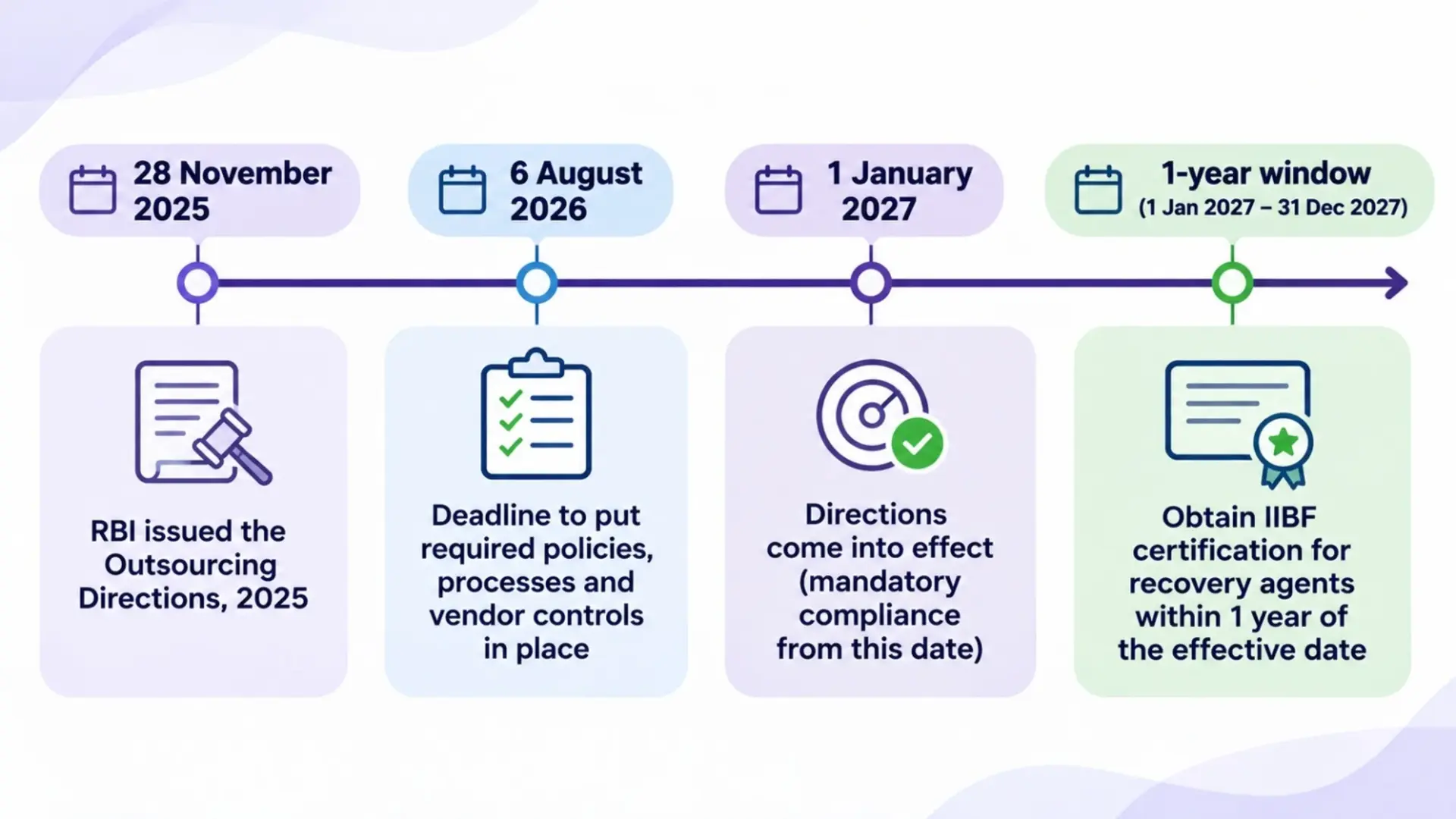
DRA certification. Agents must hold a certificate from IIBF after Debt Recovery Agent training, or from an institute tied up with IIBF (paragraph 454I, commercial banks). For NBFCs, existing uncertified agents have one year from the effective date to certify (IndiaLaw LLP, Business Standard via CAalley). The window does not cover newly engaged agents, and we have not found a stated transition for banks.
Published list. You must keep an up-to-date list of engaged recovery agencies on your website, updated within seven calendar days of a change (TaxGuru, IndiaLaw LLP).
Advance intimation. The borrower receives written details of the agency at least one day before the first in-person visit. Later changes are communicated promptly (Agrud Partners, Outlook Money).
Calls and hours. Borrowers are told calls are recorded. Call records are kept for six months from the call date, or until disposal if the matter is sub judice. Contact runs from 08:00 to 19:00 unless the borrower requests or authorises otherwise (TaxUpdate.in, Outlook Money).
The third column below is our suggestion of where each item should live. It is good practice, not an RBI requirement.
Obligation | Parameter | Where it should show up (good practice) |
|---|---|---|
Website list of recovery agencies | Updated within seven calendar days of a change | Vendor onboarding and exit workflow, with a named owner |
Written intimation to borrower | At least one day before the first in-person visit | Field allocation rules and agency service standards |
Contact hours | 08:00 to 19:00, unless the borrower requests or authorises otherwise | Dialler settings and agency conduct schedule |
Call-record retention | Six months from the call date, longer if sub judice | Data retention clause and audit rights |
IIBF certification for existing NBFC agents | One year from the effective date | Agent roster warranty and periodic certification report |
Outsourcing contracts: responsibility stays with you
A contract is a control. It is not a shield. Under the RBI (NBFC - Managing Risks in Outsourcing) Directions, 2025 (RBI/DOR/2025-26/363, 28 November 2025), outsourcing does not diminish the obligations of the NBFC, its Board or its Senior Management (TaxGuru reproduction, paragraph 9). King Stubb & Kasiva make the same point in their commentary: outsourcing does not dilute regulatory responsibility (King Stubb & Kasiva via Legal 500).
The same NBFC directions require outsourcing agreements in writing. Per paragraphs 33 and 34 of the TaxGuru reproduction, those agreements cover service standards, access and audit rights, RBI inspection rights, prior approval for subcontracting, confidentiality, business continuity and termination (TaxGuru, King Stubb & Kasiva via Legal 500). Banks and other regulated entities should check their own outsourcing directions rather than assume identical text.
Clauses worth reviewing in your vendor agreements (good practice)
These items are our suggestions for a collection agency outsourcing contract review. RBI does not prescribe this list or any model wording.
A role definition tied to function, so the contract describes what the vendor does, not only what it is called.
Named responsibility for agent certification, with evidence on request.
Named responsibility for call-recording notice, record retention and contact hours.
Prior approval before any subcontracting.
Access, audit and RBI inspection rights.
Data handling and confidentiality terms.
Termination steps linked to your seven-day website list update.
A classification review clause, so the instalment-collection point can be revisited once RBI's text is confirmed.
What is still unconfirmed, and what to check against RBI's own text
Some limits are worth stating plainly.
RBI's own direction PDFs could not be read by our research process. Quotations and paragraph numbers here come through secondary reproductions and summaries. Confirm them on rbi.org.in.
Operative wording on instalment-only collectors has not been located.
We found no transition rule for existing vendor contracts.
Whether recovery arrangements count as material outsourcing is unsettled in the sources we reviewed.
This article is general information, not legal advice. Your legal and compliance teams should read the direction applicable to your entity type.
Frequently asked questions
Who counts as a recovery agency under the 2026 directions?
An entity or individual, other than your own employees, engaged under outsourcing to assist recovery from a borrower in default, whatever the contract calls it. Its customer-facing representatives are recovery agents.
Does a Business Correspondent count as a recovery agency?
For commercial banks, yes, when the Business Correspondent is involved in recovery for the bank. NBFCs should check their own direction.
Is an agent who only collects regular instalments a recovery agent?
Vinod Kothari Consultants and a Business Standard report say such agents are not treated as recovery agents. The operative wording has not been located, so confirm against RBI's text.
When do the new rules apply?
All nine directions take effect on 1 January 2027.
Does outsourcing recovery move my regulatory responsibility to the vendor?
No. The NBFC outsourcing directions of 2025 state outsourcing does not diminish the obligations of the NBFC, its Board or its Senior Management.
Conclusion
Classification decides everything else. A "collection" label does not move a vendor outside the framework, because the definition looks at function. The instalment-only carve-out is reported by two sources but not confirmed in operative text, so any roster resting on the point carries a risk you should document. Outsourcing does not move responsibility, which makes your contract a control you operate rather than protection you hold. With the directions effective from 1 January 2027, the sorting work belongs in the coming weeks.
If you want to compare notes on how your roster maps to the definitions, we are happy to discuss your portfolio, or you can read how we build to the standards our regulated clients must meet on our regulatory compliance page. For the full change list and timeline, see our overview, RBI Recovery Practices Directions 2026: What NBFCs and Banks Must Change Before 1 January 2027.
If your regulator asked today, could you explain, vendor by vendor, why each one is or is not a recovery agency?
Sources
IndiaLaw LLP: RBI 2026 Amendment on NBFC Loan Recovery and Recovery Agents (16 October 2026)
Vinod Kothari Consultants: RBI's Recovery Norms Allow Device Locking by Lenders (7 August 2026)
Agrud Partners: RBI Loan Recovery Rules 2026 – Business Conduct Directions
TaxGuru: RBI (NBFC – Managing Risks in Outsourcing) Directions, 2025 (RBI/DOR/2025-26/363)