How to Write a Standalone Recovery Policy Under RBI's 2026 Directions
RBI's 2026 directions take effect on 1 January 2027 and name the items every lender's recovery policy must address. This guide sets out eight policy sections, separates what the directions require from what you decide, and lists the evidence to ask each recovery partner for before the deadline.

Many recovery policies list controls for agencies and then give the lender no way to check them. The 2026 RBI directions make this gap harder to carry. Each regulated entity must put in place a policy on collection and recovery of loan dues, and the directions name the items the policy has to address (RBI NBFC Directions, RBI Commercial Bank Directions).
The practical answer: write your recovery policy as a dedicated document, section by section, against those items, and ask each recovery partner for evidence against every section before the directions take effect on 1 January 2027.
What the 2026 directions require, and from when
On 6 August 2026, RBI issued nine Amendment Directions on the conduct of regulated entities in recovery of loans and engagement of recovery agents, one for each entity type (RBI Press Release 2026-2027/827). They follow a revised draft issued in May 2026. The directions come into effect on 1 January 2027, so as of 6 November 2026 they are not yet in force.
Two of the nine will cover most readers of the RBI guidelines for recovery agents:
The Reserve Bank of India (Non-Banking Financial Companies - Responsible Business Conduct) Third Amendment Directions, 2026 (RBI/2026-27/230), where the policy requirement sits at paragraph 100D (RBI).
The Reserve Bank of India (Commercial Banks - Responsible Business Conduct) Fourth Amendment Directions, 2026 (RBI/2026-27/223), where the parallel requirement sits at paragraph 454D (RBI).
Housing finance companies follow a different route. Their direction (RBI/2026-2027/231) replaces the old recovery-agent section with a new one requiring HFCs to comply with the NBFC provisions by cross-reference (RBI HFC Directions).
If you run an HFC or another entity type, read your own direction before you adopt any paragraph numbers from this guide.
Scope matters for drafting. The provisions apply to recovery from borrowers in default, and apply to collection in the normal course only where the directions say so explicitly (RBI NBFC Directions).
Does the recovery policy have to be a separate document?
This question shapes the whole policy, and the answer is narrower than much of the commentary suggests.
The directions require a policy on collection and recovery of loan dues. The NBFC and bank paragraphs we reviewed do not say this policy must be separate from the outsourcing policy. They do say due diligence on recovery agencies must conform to RBI's outsourcing directions (RBI Commercial Bank Directions). So the two policies connect, and the recovery policy has to point to the outsourcing framework for due diligence.
Keeping the recovery policy as its own document is a drafting choice. One advisory firm, Vinod Kothari Consultants, recommends the recovery policy stay distinct from the outsourcing policy (Vinod Kothari Consultants). We suggest the same for a practical reason: a dedicated document is easier for a recovery partner to map its controls against, and easier for an auditor to test.
This is what "standalone" means in this guide. The directions do not require it.
Approval works the same way. The word "Board" does not appear in the NBFC or bank paragraphs we reviewed. One law-firm note describes the policy as approved in accordance with the lender's governance framework (KS&K). Approval at a senior level, ideally the Board, is good practice. Treat it as your governance decision, not as an RBI requirement.
A section-by-section structure you can adapt
The outline below follows the items the directions list. The directions say what the loan recovery policy must address. They leave most of the content inside each section to you. Each section carries one of three tags:
Required: the directions name the item.
Design choice: the item is required, and the lender sets the detail.
Good practice: not named in the text we reviewed, but useful.
The partner-evidence column is our practical suggestion, not an RBI requirement.
Policy section | What the directions require | Who decides the detail | Partner evidence (our suggestion) |
|---|---|---|---|
1. Scope, triggers and graded escalation | Triggers and a graded escalation matrix | Lender | Workflow mapped to your stages, with stage-level logs |
2. Agency eligibility and due diligence | Eligibility and due diligence, aligned with outsourcing directions plus IIBF DRA certificate for agents | Lender, within RBI rules | Per-agent certificate register, due-diligence pack |
3. Code of conduct and contact rules | A code of conduct and an agency undertaking plus contact only 08:00 to 19:00 | Lender sets the code | Signed undertaking, training records, contact-time controls |
4. Recording, records and the agency list | Call content recorded and kept six months plus agency list updated within seven calendar days | RBI sets the parameters | Retrieval demonstration, change notices |
5. Monitoring, evaluation and inspection | Performance evaluation, inspection, audit and control plus a management structure | Lender sets frequency and metrics | Audit access, MIS, complaint and exception logs |
6. Penal actions | Penal actions against non-compliant agencies | Lender sets the ladder | Contract acceptance, corrective-action record |
7. Compensation and device terms | Compensation for loss from non-compliant actions plus device restrictions where relevant | RBI sets device parameters | Incident-to-remedy records |
8. Recovery on demise and financial distress | Both must be addressed | Lender | Training and routing to the lender |
Sources for the table: RBI NBFC Directions and RBI Commercial Bank Directions.
1. Scope, triggers and graded escalation
Required. The policy must address the triggers for recovery and a graded escalation matrix (RBI NBFC Directions). The stages, the actions allowed at each stage and the people who approve a move up the matrix are yours to define. Start by stating the scope: recovery from borrowers in default, with normal-course collection included only where the directions specify.
Your partner should show how its workflow maps to your stages, and prove each action was taken at the right stage and logged.
2. Agency eligibility and due diligence
Required. The policy must cover eligibility criteria and due diligence for recovery agencies (RBI Commercial Bank Directions). Due diligence must conform to RBI's outsourcing directions, so cross-refer to your outsourcing policy here rather than repeat it.
Eligibility of recovery agents under the RBI directions turns on certification. Agents must hold the IIBF Debt Recovery Agent certificate. For NBFCs, existing agents have one year from the effective date to obtain it (RBI NBFC Directions).
The bank direction we reviewed states no such transition, so do not assume one. Check your own entity's direction.
Staff and agents must also display an identity card, and an agent must carry an authorisation letter (RBI NBFC Directions, RBI Commercial Bank Directions).
Request an agent-level certificate register, the partner's due-diligence pack and its ID card and authorisation-letter practice. At e-Solve, founded in 1997, we work with 2,500+ DRA-certified agents across 17 Indian states, and a per-agent register is how a lender can see certification instead of taking it on trust.
3. Recovery agent code of conduct and contact rules
Required. The lender must adopt a code of conduct for recovery agents and its own employees, and obtain an undertaking from each agency to abide by it (RBI Commercial Bank Directions). The directions require the code. What goes into your code is your design, built on the conduct rules in the directions.
One rule is fixed: contact and visits only between 08:00 and 19:00 (RBI NBFC Directions).
Ask your partner for the signed undertaking, training and attestation records, and proof the contact window is enforced in the dialler and the field app, not left to memory. Customers deserve calls at reasonable hours, and a system control is the only way to prove they got them.
4. Recording, records and the list of agencies
Required. Recovery call content is recorded, and records are kept for six months from the call date, or until disposal where the matter is sub judice (RBI NBFC Directions). Your policy should state who holds the recordings and how fast you can retrieve one.
The lender must also keep an up-to-date list of empanelled agencies on its website and update the list within seven calendar days of any change (RBI Commercial Bank Directions).
A partner should demonstrate retention and retrieval, and commit to notifying you of agency changes in time for the seven-day update.
5. Monitoring, performance evaluation and inspection
Required. The policy must cover performance evaluation, inspection, audit and control of recovery agencies, and the lender must put in place a management structure to monitor and control them (RBI NBFC Directions).
Design choice. The directions do not set a review frequency or metrics. You decide both. Write them down, because an unwritten frequency tends to become "when there is a complaint".
Outsourcing the work does not move your regulatory responsibility to the partner. Ask your partner for audit access, a regular MIS pack, complaint and exception logs, and its remediation history.
6. Penal actions against non-compliant agencies
Required. The policy must provide for penal actions against agencies that do not comply (RBI Commercial Bank Directions). RBI does not quantify the penalties. You set the ladder, from warning to termination, and the triggers for each step.
Bind your partner to the ladder in the contract, and request any record of corrective action it has taken.
7. Borrower compensation and device-restriction terms
Required. The policy must provide for compensation to borrowers and guarantors for loss caused by recovery actions that breach the directions (RBI NBFC Directions).
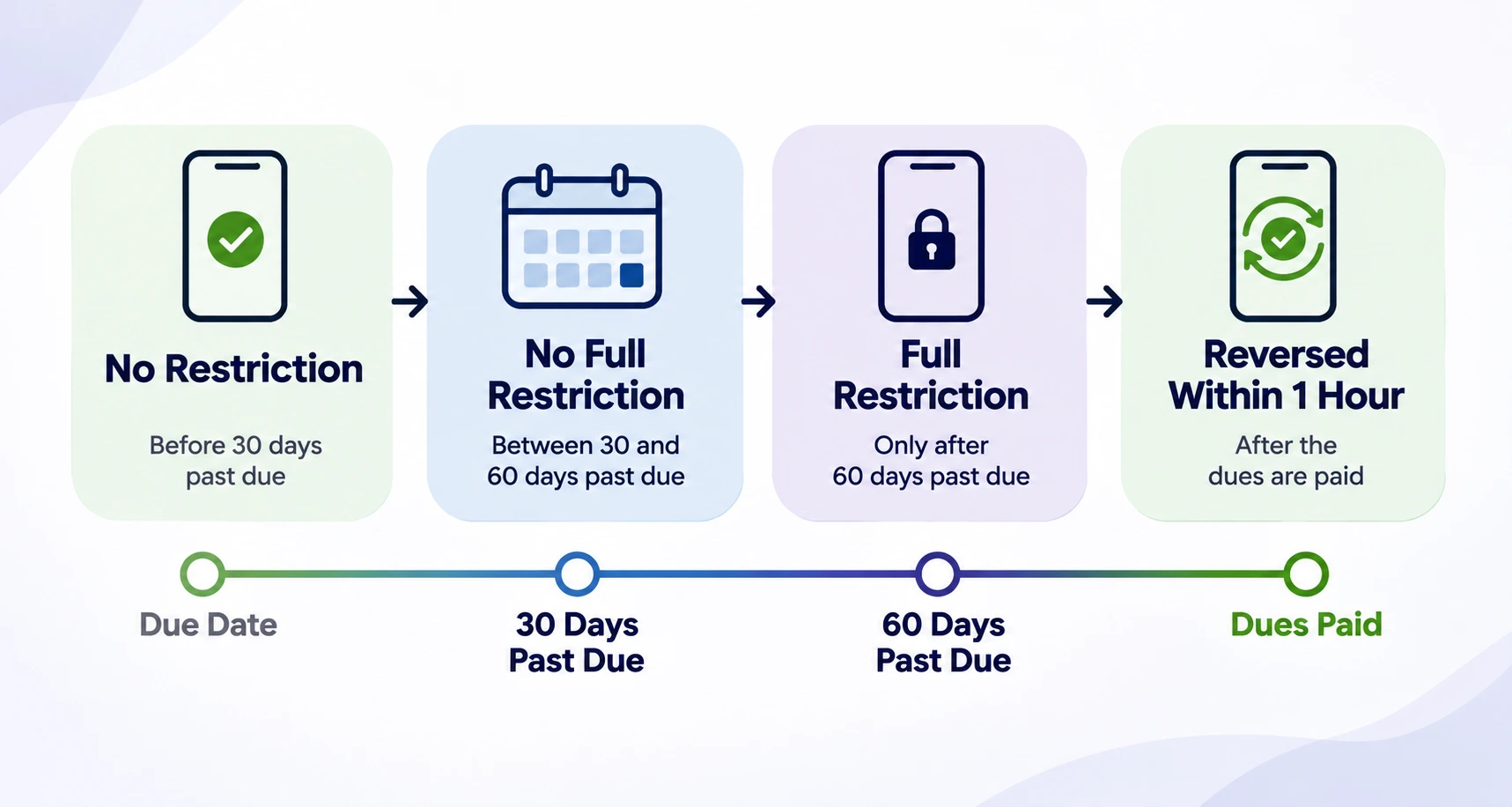
Device terms apply only where you financed the device. No restriction before 30 days past due, full restriction only after 60 days past due, and reversal within one hour of the dues being paid. For wrongful restriction or delayed reversal attributable to the lender, compensation is Rs 250 per hour, capped at the loan amount disbursed (RBI Commercial Bank Directions).
Request records showing how fast an incident reaches you and how fast it is remedied.
8. Recovery after a borrower's death and the financial-distress framework
Required. The policy must address recovery on the demise of a borrower and a framework for borrowers in financial distress (RBI NBFC Directions). Read the full text of your direction before you write this section, and keep decisions on these cases with your own staff.
Ask your partner how its staff are trained for these conversations, and how such cases are routed to you for a decision rather than handled in the field.
What a recovery partner should supply as evidence
Turn the policy into a diligence request. These are our suggestions, built from the requirements above:
A per-agent IIBF DRA certificate register.
A due-diligence pack aligned with your outsourcing policy.
The signed code-of-conduct undertaking and training records.
Proof the 08:00 to 19:00 window is enforced by system.
Call-recording retention and retrieval on request.
Timely notice of agency changes for your website list.
Audit access, MIS and complaint logs.
Contract acceptance of your penalty ladder.
Red flags are simple to spot:
The partner cannot produce certificates agent by agent.
The partner resists audit access.
The partner cannot show how the contact window is controlled.
We build our operation to the standards our regulated clients must meet. We are not regulated or approved by RBI, and no partner should claim to be.
Required, design choice or good practice: keeping the policy honest
A recovery policy gets weaker when it states rules the directions do not contain. Keep three lists:
Required: the policy itself, triggers and escalation matrix, code of conduct and undertaking, eligibility and due diligence aligned with outsourcing directions, evaluation and inspection, penal actions, compensation, recovery on demise and the financial-distress framework.
Design choice: the contents of the escalation matrix, review frequency and metrics, and the penalty ladder.
Good practice: a dedicated document, and approval at a senior level, ideally the Board.
We read the RBI notification pages in HTML, not the PDF versions. This guide is general information, not legal advice. Confirm the wording in your own entity's direction before you finalize.
Frequently asked questions
When do the directions apply, and to whom?
From 1 January 2027, through nine parallel directions, one per entity type (RBI Press Release). Use the direction for your entity.
Must recovery agents be certified?
Yes. Agents must hold the IIBF DRA certificate. NBFCs get one year from the effective date for existing agents. The bank direction we reviewed gives no transition (RBI NBFC Directions).
What do we ask a partner for on contact hours and recordings?
System proof of the 08:00 to 19:00 window, and retrieval of recorded call content within the six-month retention period (see sections 3 and 4).
Conclusion
A recovery policy is ready when each of its eight sections has an owner inside your organization and a partner can evidence every section from its own records before 1 January 2027. Write to the items the directions name, mark what you decided yourself, and keep good practice labelled as good practice. If you want to see how we evidence these controls, read our regulatory compliance page or talk to us about your portfolio.
Which section of your current policy would you struggle to prove with a partner's records today?
Sources
Reserve Bank of India, Press Release 2026–2027/827, 6 August 2026
RBI: NBFC Responsible Business Conduct—Third Amendment Directions, 2026
RBI: Commercial Banks Responsible Business Conduct—Fourth Amendment Directions, 2026
RBI: Housing Finance Companies—Third Amendment Directions, 2026
Vinod Kothari Consultants: RBI’s Recovery Norms Allow Device Locking by Lenders
Corplawupdates: RBI Amendment Directions on Recovery of Loan Dues and Recovery Agents
Taxmann: RBI’s Revised Draft Directions on Recovery of Loans and Recovery Agents